



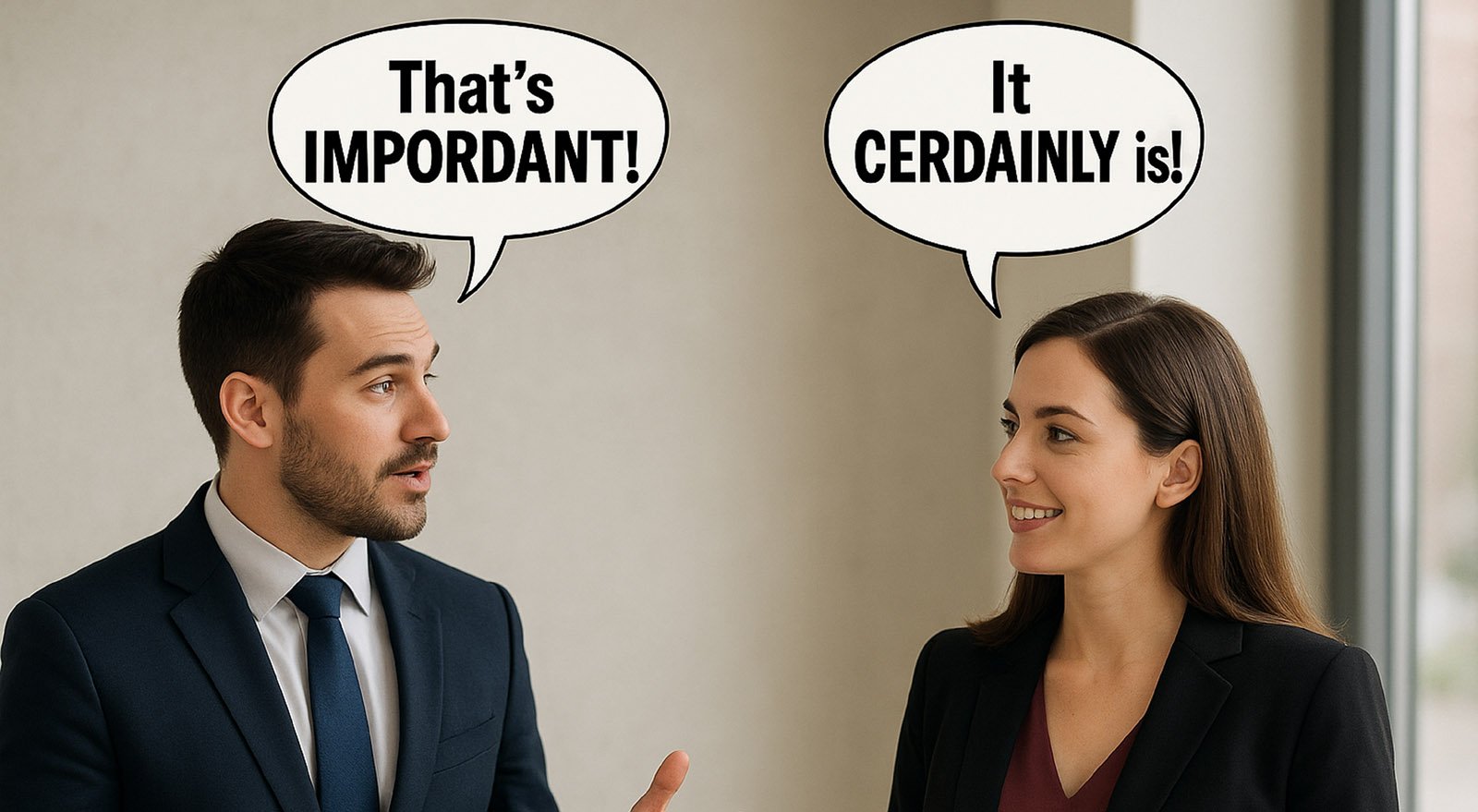
Have you ever uttered the word button or Manhattan and wondered, “What happened to the T-sound?” And if you then tried to fix your pronunciation, you may have ended up sounding accidentally British, with way more of a posh, bursting T than is typical for Americans. “Buh-Tun…Man-ha-Tun… hmmm, that doesn’t sound right to me either!”
Or maybe you consistently have that traditional American hiccup-y sound where the medial T lives in a word like impor/t/ant—but when you meet youngsters or hear them on TV, you do a double-take when you hear them sub in a different sound. These generational speech differences (or Modern English speech changes) may seem jarring and almost arbitrary.
And I contend that this is actually headline language news: Many millennials and Gen Z Americans reject the glottal stop variant of the /t/ sound. Ladies and gentlemen, we are in the midst of an emerging dialect change!
What is a glottal stop?
The glottal stop or glottal plosive is a distinctly guttural sound written with a [ʔ] symbol in the International Phonetic Alphabet notation. You produce it by quickly closing the space between the vocal cords (the glottis) to momentarily stop airflow and vibration. When you release this posture, a slight choking or cough-like explosion results in the back of the vocal tract. In American English, it’s a common phonetic variation (or allophone) of /t/. It’s a very choppy sound, and if you use it in gibberish language play, it may sound like a bad impression of German.
What is the role of the glottal stop in American speech patterns?
This interesting sound is a common part of Standard/General American English. Speakers employ the glottal stop in three main contexts.
PATTERN #1:
In place of the written letter “t” in a very particular linguistic environment. There’s a bit of a complex formula to this one:
…is followed by one or two T’s (“t” or “tt”) in the spelling
…and that is followed by an unstressed syllable consisting of a syllabic
N ([n̩]) —(which is where N takes up the meat of a syllable.)
You can hear examples of this sound combination in words like satin, curtain, important, and forgotten. As you can see, these words can be written with one or two “t”s followed by at least one vowel (although you end up ignoring these vowels) and then an “n.” Some speakers, especially in common words, also do this when an N [n] or an L/Dark L [ɫ] precedes the T, as in mountain and Fulton.
This pattern is absent from many dialects of English, including Standard British English.
PATTERN #2:
To separate vowels so words with side-by-side similar vowels (without their own natural separator) don’t blur together. In this case, they do not correspond to a written letter. Instead, they are activated to serve a different function—namely airflow and intelligibility. Using the symbol “||” to show the break in airflow, English glottal stop examples of this type include words like: uh||oh and C||EO. Without the glottal stop separating the similar Long E vowels, CEO see||ee-ohh (Chief Executive Officer) can sound like CO see-ohh (Corrections Officer). Both are vital yet very different positions in the working world, so mishearing this title could cause a lot of confusion for the listener.
In contrast to the previous pattern, this pattern is quite common in dialects of English—and is often used for clarity, especially in careful speech.
PATTERN #3:
To start the release of breath, between silence and a starting vowel. Linguists may describe this as the “hard attack” before a vowel when it begins in phrase-initial position. As in the last example, these glottal stops do not correspond to a written letter. You can hear this in the beginning of the phrase ||Anybody home? or in ||Enough already! This one happens pretty automatically for speakers as they go from a resting position to phonating or vibrating their vocal cords when there is no natural glide into the sound. It’s more like a natural jump from not making sound to making sound where there is no given on-ramp.
This pattern is also extremely common, and not just across dialects of English, but in languages around the world.
In addition to the above patterns, you’ll hear robust glottalization in dialects of English such as Cockney (e.g. in words like better, little) and even in some older dialects of Brooklyn English (in words like bottle) and other English varieties too.
The shift: Many Millennials/Gen Z avoid it where possible
Anecdotally—and more often every year—I hear younger native speakers avoiding the Glottal Stop where Generation X and older speakers would indeed use [ʔ] in place of /t/ (corresponding to Pattern #1 above). Two alternatives swoop in to sidestep this sound:
- The Tap or Flap [ɾ] (a fast “D-like” sound)
- Aspirated T [tʰ] (with a burst of air) where the glottal stop used to live
Just listen to a young podcaster, and you’ll likely hear the word “impordant” (important) or the phrase, “Click the like buddin” (button). It can even cause confusion among native speakers who don’t use this pattern, so a word like written, pronounced as “wridden” may be understood as ridden. As a New Yorker, I often hear real estate agents networking. They often talk about their properties in Manhattan, and the variation in pronunciation of this word seems to vary by age group—and that inspired this very blog topicǃ
NOTE: American Millennial and Gen-Z use of the tap/flap in place of the glottal stop would occur when a vowel or vowel+R precedes the T and syllabic N, but would NOT occur when N or L (Dark L) are present before the T + syllabic N combination. Therefore, a tap/flap would NOT occur in words, such as last names Clinton or Bolton.
I’ve heard this more from Gen Xers and some Baby Boomers, typical business professionals, teachers, or presenters. I’d call this a bit hypercorrection—potentially being confused when confronted with our own spelling. When I taught Adult ESL (English as a Second Language) onsite on Long Island, I overheard a fellow teacher speaking with a student. She showed the word “kitten” on the blackboard and pronounced it [kɪ.ʔn̩]. As a beginner, the student pronounced it with the T’s as spelled, [kɪ.tɛn̩]—instead of with the Standard American English pronunciation. She then repeated the word his way—as if she caught her own error. For the record, I also saw this teacher do the same with the word better (which would have the d-like flap rather than a T). This is not to knock the teacher, but to reveal that native speakers—even those who teach the language—are often unsure and even unaware of the underlying phonemic patterns within the American English dialect that sometimes varies from the spelling.
NOTE: Unlike the above tap/flap, American Millennial and Gen-Z may indeed sub in an aspirated T when N or L is present before that T + syllabic N combination. Thus, they are likely to use [tʰ] in such words, including last names Clinton or Bolton.
And now, an interesting public example showcasing the changing usage of the glottal stopǃ I was excited to witness a change coming from the same speaker over time, specifically in television ads for Hilton Hotels featuring actress, Anna Kendrick. The TV spots that originally aired featured Kendrick pronouncing a noticeable glottal stop in Hil[ʔ]on. A few months later, new spots emerged that clearly replaced these glottal stops with an aspirated T in Hiltʰon. This showed me—and to quote the movie, All the President’s Men—“somebody got to herǃ” I would hazard a guess that, whether for posh stylistic or brand-guided reasons, Hilton advertising executives wanted Ms. Kendrick to make a change to resonate with specific viewers—to mirror the burgeoning glottal stop avoidance pattern that is becoming ever-popular with the younger demographic, the target audience that she may appeal to the most. (NOTE: Although Kendrick is technically a millennial herself, she’s likely more traditional in her speech patterns as a trained actor and former stage performer. So her initial pattern was consistent with the more traditional standard.)
So, why do Americans avoid using the glottal stop? (Namely in Millennial or younger age groups)
My hypotheses include the following tenets or forces working together:
- Spelling pressure: “T” should sound just like the alphabet letter “tee” with which it’s written, mimicking the letter’s sound in the alphabet. Linguistic trends in millennials and Gen Z speakers may favor more literal interpretations of what one thinks a “T” should be. (Similar trends that support this are adding back traditionally silent Ls in words like palm.) Variations that stray from the spelling are questionable and, therefore, dispreferred.
- Aesthetic preference: People prefer smoother and lower-effort sounds as compared with harsh or “throaty” sounds. Also, this could show a preference towards sounds found in romance languages (like the tap/flap) and trend away from the more guttural sounds from Germanic language roots of the English language. This could also reflect the demographics of incoming populations where Spanish is more dominant than German, for example.
- Influencer diffusion: Why millennials avoid the glottal stop so often these days isn’t so different from other English language trends. When people hear their peers or public figures using the sound, the pattern spreads like wildfire and becomes normalized, especially among younger speakers who aim to sound like people they admire.
Fast FAQ—Asking for a friend (Quick tips and advice for curious native speakers and English learners alike)
- Is the glottal stop “wrong”? Or are these speech habits in young Americans incorrect? What should be vocal articulation for those special Ts be?
No. The glottal stop speech pattern is a native, rule-governed feature in American accent phonology. It’s a typical feature of Standard American English (SAE) also known as General American English (GAE). As proof, you can even find it in the dictionary—although potentially showing up with a missing vowel between the T and N. The Oxford English Dictionary, for example, transcribes the word “litany” as /ˈlɪtn̩i/ - How is a tap/flap different from a glottal stop?
The tap/flap [ɾ] in a word like latter or ladder uses a quick flick of the tongue touching the gum ridge (or alveolar ridge) in Standard American English. It is also a “voiced” sound, using the buzz of the vibrating larynx or vocal folds. I like to refer to it as a fast action-D. The glottal stop [ʔ], on the other hand, closes the vocal folds—and uses the glottis, which is the gap between the vocal cords that can open and close. It is voiceless or unvoiced and the vocal cords do not vibrate or phonate while making this sound. Therefore, the sounds differ in location, in airflow style, and in voicing. - Do all Americans use it?
No—there’s regional, stylistic, and generational variation. This appears to be an active linguistic trend more common among millennials and Gen Zers. The United States is a melting pot, so English phonetics and phonology is particularly dynamic! And, how millennials pronounce English differently doesn’t make this version of English better or worse, it’s just not part of the “standard”—at least not yet. - I’m an American Millennial / Gen Zer…should I use the glottal stop for some Ts or not?
That depends! If you’re attempting to sound clear and confident for business or formal settings for an American English-speaking audience, I would indeed recommend using the glottal stop in the three patterns I demonstrated above. That said, perhaps you don’t enforce these rules as much in social settings if it makes you feel more comfortable or relatable to your peer group. So you could code-switch between the two accent patterns as you see fitǃ
In fact, in my work with actors seeking American dialect coaching, we dive into the character and their influences before choosing whether a Millennial or Gen Z character uses this aspect of the accent. - I’m a non-native English speaker and want to sound like my peers. How can I find out what my American friends use?
I invite you to conduct a mini experiment with willing friendsǃ Ask them to read a sentence like this: “I’ve written a mountain of important books about the trends of gluten, water fountains, and buttons at the Hilton Hotel in Manhattan.” Please feel free to share your findings with me and the growing community of fellow language geeks who follow the SpeechFox.
Studying sociolinguistics in the US (and speech sounds analysis) can be so much fun—and I highly encourage doing your own field research! - I’m a native English speaker and I’m unsure whether to follow this trend! What speech coaching tips for American pronunciation can you offer?
Modifying your current accent or pronunciation habits is a very personal decision (and may be a business one too). People often like to mirror their peer group in social situations but maintain a more standard sound for business. So if these sounds differ, you don’t need to choose just one! And if you need support, accent coaching for Americans born in the USA can be just as useful for building confidence as it is for non-native speakers.
Bottom line
Understanding when and how to use—or avoid—the glottal stop in American English gives you options. Style is yours to choose; clarity is yours to control.
If you want focused practice on American English pronunciation—including choosing between [ʔ], [ɾ], and [tʰ] for the room you’re in—or the character you’re portraying in a film—I’d love to help. I offer pronunciation coaching techniques and strategies to empower my clients. I coach executives, teams, and public figures to speak clearly, confidently, and authentically in high-stakes settings on and off Zoom. CONTACT ME if you want to explore English accent reduction (AKA accent modification and coaching or accent training for professionals) or other speech support services.