

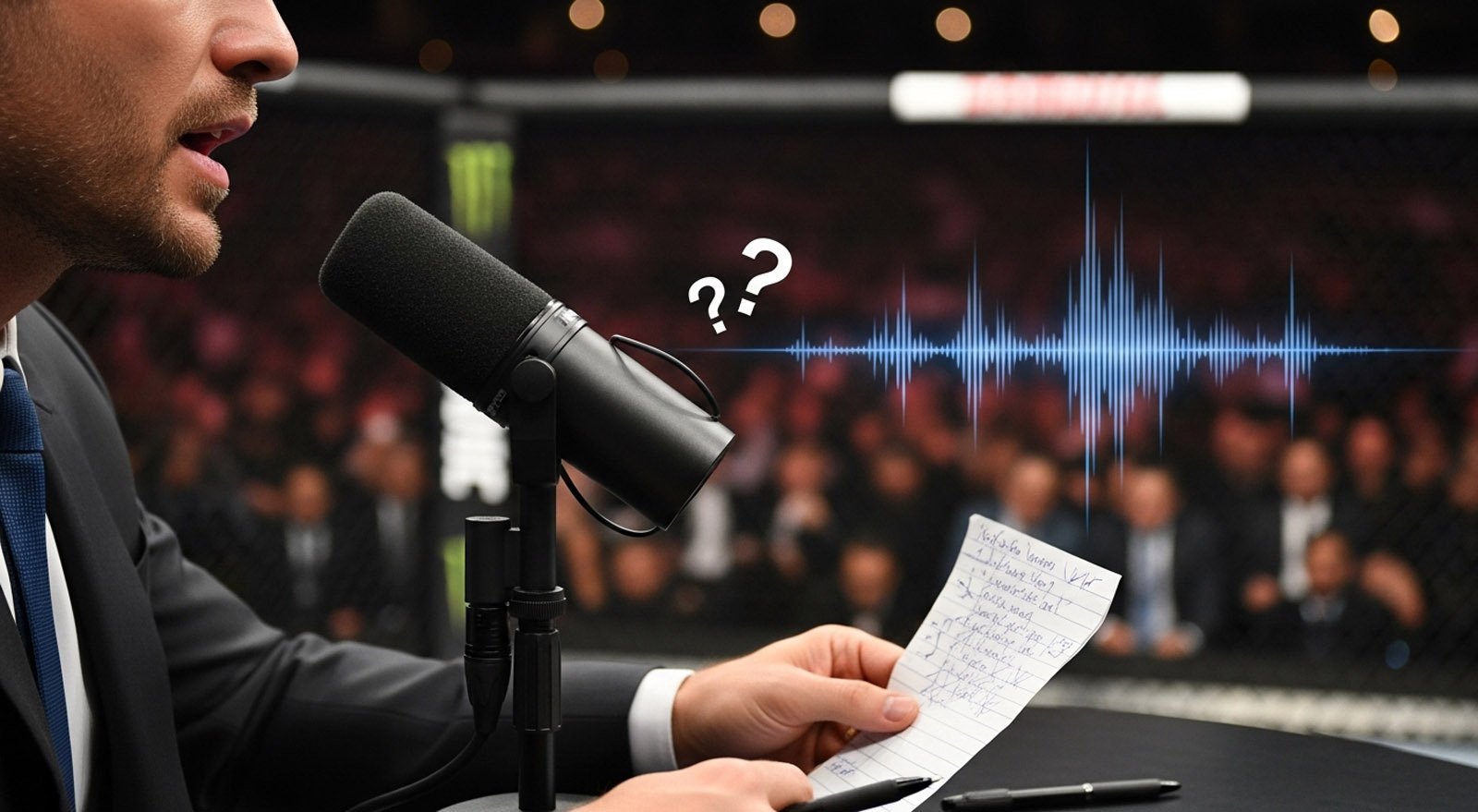
MMA is a global sport. The UFC’s roster is global. Its fanbase is global. And yet, on English-language broadcasts and podcasts, pronouncing a fighter’s name accurately can feel optional.
Sometimes it’s a small vowel substitution. Other times, the emPHAsis lands on the wrong sylLAble. Names can get so “English-ified” that they become unrecognizable. And occasionally, it becomes a running joke—because humor can be a handy shield when you’re not confident you can say something correctly.
If you’ve ever found yourself asking, “Why do UFC commentators and other MMA announcers mispronounce fighters’ names so badly?” you’re not alone. And to be clear: this isn’t a demand for perfection, an MMA broadcast criticism for sport, or even a dunk on monolingual English speakers. It’s a shout-out to encourage professionalism in UFC commentary and sports broadcasting in general—because fighter names aren’t trivia. Fighter names represent the identity, brand, and heritage of the athlete, plus the credibility of the announcer, MMA organization, and Paramount+ (CBS Sports) streaming service as a whole.
This article was inspired by none other than The American Gangster, Chael Sonnen. On the recently concluded podcast, Good Guy / Bad Guy with Daniel Cormier, Sonnen routinely pronounced UFC fighter names in a way that felt like comedy first, accuracy second. Whether this was intentional or just a bad habit, the effect was the same: it trained audiences to treat non-English names like punchlines. And I’m guessing he dealt with being called “shayl SAH-nen” instead of “chayl SUH-nen” most of his life, so perhaps this is his version of payback.
And here’s the thing from a UFC broadcast analysis standpoint. In a sport this international, pronunciation is part of broadcast craft. It’s also part of what I coach—not only media training for athletes (native and non-native English speakers) but also sports broadcast pronunciation coaching for commentators, announcers, and podcasters (or other sports show hosts) who want to sound confident without guessing or otherwise taking shots in the dark.
MMA is global. Names are global. UFC fighter name pronunciation is part of the job.
The UFC’s (Ultimate Fighting Championship’s) talent roster is a map of the world—Mexico, Brazil, Spain, Poland, Georgia, the Czech Republic, Dagestan, South Korea, China, and beyond. That’s part of what makes MMA so exciting.
But many commentators, announcers, and podcasters are monolingual English speakers. That’s not a character flaw, it’s just a reality. But because of this, tackling (or, as I like to say, hacking and unpacking language) is not a skill they have just yet. They don’t seem to have a toolkit that provides the magic decoder ring. So currently, UFC announcers and commentators seem to fall into three different groups—those who
- Care about, prepare, and practice pronunciation. Jon Anik and Kenny Florian seem to put some real TLC into their field research, practice, and mastery! The dedication is impressive and reveals attention to detail and pursuit of excellence.
- Skate past the name and hope nobody notices the inaccuracies. Former double-champ Daniel Cormier may ask a colleague on the fly or attempt to mimic but often gives up and parrots the last thing he hears (or believes he’s heard), whether it’s from a reliable source or not—granted he does appear to care about the feelings of his fighting colleagues.
- Lean into comedy at the expense of accuracy. Chael Sonnen, infamous bully that he is, makes a mess, and a literal mockery, out of the perceived alphabet soup he encounters. If he incidentally does get close to being accurate, he often revisits the name and hypercorrects it by chopping the syllables into existing English words to make matters worse. It seems he intentionally exacerbates his instinctual mispronunciations until they devolve or morph to become unrecognizable!
When athlete names sound consistently off—especially for prominent fighters—it creates three avoidable problems, as it mayː
- Confuse or misinform fans
- Create a respect gap for athletes
- Cause credibility loss for the broadcast
So, why do UFC commentators and other sports broadcasters or announcers mispronounce names?
Mispronunciation of non-English names typically stems from three common reasons:
1) English spelling rules don’t apply across languages
When English speakers apply English rules to another language, they often miss the target. The Stan Wawrinka example is a great one, as treating “wr” as having a Silent W is an English spelling nuance, not a universal one.
2) Stress and rhythm get misplaced
In high-octane commentary, announcers often default to English syllable stress patterns. When stress shifts, intelligibility drops—even if the consonants are close enough.
3) A confidence shortcut: turn insecurities into a joke
If a commentator feels uncertain, they may reduce effort using speed to gloss over names, use familiar-sounding sound patterns, or turn their shortcomings or potential mistakes into humor by piecing names into a silly collage of English words.
And this isn’t about political correctness. It’s about sounding prepared, informed, and like an in-the-know insider.
The UFC Pronunciation Standard
Let’s set a realistic target for Broadcast-Safe pronunciation. Not “perfect native speaker,” but rather, intentional and respectful.
That means:
- Correct syllable stress
- Reasonable approximations of consonants and vowel sounds—if we have it in our inventory, use it (even if different than English phonics), and if we don’t have it, pick the closest option. (Or go for the gold and attempt the sounds of the native language!)
- Consistency across the team, at least in preparation and effort
Hot tip: get that stress pattern right. Even if you don’t nail every vowel and consonant, correct syllable stress makes a name recognizable and more respectful.
A pronunciation card: help with challenging UFC fighter names
Below are some athlete names with spotty, or even questionable, English-language coverage in the UFC.
| Fighter | Country / Region | Language Context | Common Mispronunciation | Pronunciation Tips |
|---|---|---|---|---|
| Magomed Ankalaev |
Russia (Dagestan) | Russian + regional variants | mega-med uncle-LIE-off |
MAH-guh-med ahn-kuh-LIE-off |
| Alex Pereira |
Brazil | Brazilian Portuguese | pee-AIR-ruh, puh-RARE-ruh, peh-HAY-duh |
puh-DAY-duh |
| José Aldo |
Brazil | Brazilian Portuguese | HOH-say (Spanish-style) | zho-ZAY ~jo-ZAY |
| Renato Moicano |
Brazil | Brazilian Portuguese | ruh-NAH-do | hay-NAH-toh |
| Merab Dvalishvili |
Georgia | Georgian | dah-shaz-VIL-ee dah-wah-lish-Willy |
dvah-lish-VEE-lee |
| Jack Della Maddalena |
Australia (Italian surname) | English / Italian surname | de-luh-LAY-ma | DEH-luh mah-dah-LAY-nuh |
Some Hot Tips for Pronouncing Brazilian Portuguese Names
In Brazilian Portuguese, an R at the beginning of a word or a double-R (“rr”) in the middle of a word is produced with a breathy sound similar to the English H. However, a single R in the middle of a word is pronounced with a flap (similar to a fast D, like the American pronunciation of the T’s in better).
Therefore,
- Ferreira is pronounced fuh-HAY-duh
- Pereira is pronounced puh-DAY-duh
This also connects to the popular Brazilian Portuguese name “José.” Also, the J in Brazilian Portuguese corresponds to the “zh” sound in garage, beige or borrowed French word, genre—different from Spanish, where it sounds more like an “h” or, better yet, the throaty [x] as in the Yiddish word chutzpah.
So,
- The Spanish language name, José, is pronounced ho-SAY
- The Brazilian Portuguese name, José, is pronounced more like jo-ZAY (or, more accurately, zho-ZAY)
And it’s Not Just MMA: Name Pronunciation Suffers Across Many Sports with International Athletes
This pronunciation challenge from linguistically diverse athlete names applies equally to other sports—not just MMA. In tennis, you’ll hear Swiss names like Stan Wawrinka vah-VRINK-uh get “smoothed” into a more English-friendly wuh-RINK-uh even though many Swiss German speakers land closer to vah-VRINK-kah (the W as a V-sound is the tricky part). Just listen to former champion, John McEnroe. And Spanish names get subtly revised too: The famous Rafael Nadal has a Spanish surname that is essentially nah-DAHL, all vowels in the English phonetic inventory (albeit with a softer Spanish D), so nih-DAEL feels unnecessarily Anglicized. In basketball, early broadcasts famously struggled with names like Giannis Antetokounmpo, to the point where announcers and players publicly explained the target pronunciation. In baseball, mispronunciations can go instantly viral—like when an NFL analyst Kirk Herbstreit completely butchered superstar Shohei Ohtani’s name on-air—mocking fans characterized the pronunciation as Sho-han Oh-tony on social media.
And in soccer and hockey, the same pattern shows up every season: fast-paced commentary plus unfamiliar spelling leads to repeated “house pronunciations” that drift away from what players and international fans actually say.
Olympic sports may be even more of a mispronunciation party, as commentators have a diverse array of athletes from around the globe—and they may be relatively unfamiliar with some of the competing Olympians, as opposed to a commentator who specializes in one sport where they have a more focused expertise.
A simple 4-step pronunciation system for commentators, announcers, and podcasters
If you’re searching how to pronounce “foreign” UFC/MMA fighter names, here’s a system that worksː
- Go straight to the sourceǃ
Ask the fighters themselves or find a clip of athletes saying their own names. You might even ask them both how to say it in their native language and how they typically teach English speakers to get close. Merab Dvalishvili provided a wonderful tutorial for the world, blackboard, pointer, and all.
- Blast out the loud syllable(s) with CAPITAL LETTERSǃ
Mark the name with obvious stress cues with CAPSː
E.g. zho-ZAY, or if typewritten, add more fanfare like, zho-ZAY
Or, if you are working with already typed text, mark with a tilde over the loud syllable(s)—or its main vowel:
E.g. zho-záy
- Identify key sounds where pronunciation differs from that of English spellingǃ
Transliterate the name, meaning rewrite the consonants or vowels where the spelling would lead to a different pronunciation in American (or your dialect of) English, so that you end up with the desired sound. If you’re an IPA-nut like me, you can use that—but for most normal people, use whatever triggers you to approximate the desired sound:
E.g. Pereira 🡪 puh DAY duh or [pə.ɾeiː.ɾə] and Wawrinka 🡪 vah VRINK kuh or [va.vɹɪŋ.kə] - Sneak up on it… Practice in contextǃ
Don’t just say the name in isolation, use it at speed and in context. Perhaps inside a fight-call sentenceː
E.g. “And now… puh-DAY-duh presses forward! puh-DAY-duh with a brutal headkick!”
That’s how you build automaticity—the same way athletes build muscle memories.
Contact / Work with Me
If you’re a sports commentator, announcer, or podcaster, I teach fast, practical name-pronunciation systems you can use in real time—stress cues, phonetic shorthand, and repetition strategies—so “foreign” names come out accurately without slowing down your delivery.
And, if you’re an athlete and you want to sound clear, confident, and camera-ready in English for interviews, pressers (press conferences), and sponsor media, I can help.
If you’d like to improve your speech impact and explore working with me, reach out through the contact form at SpeechFox.com.